
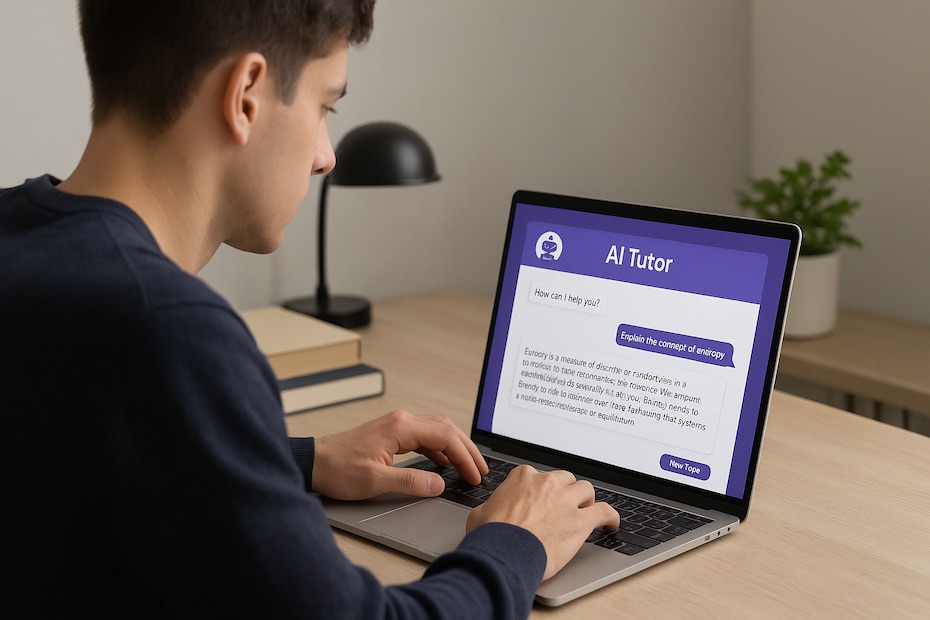
AI tutors enhance your learning by offering personalized feedback, adaptive instruction, and real-time performance analysis—helping you study faster and retain information longer.
Artificial intelligence has moved beyond being a buzzword; it’s now a practical companion for learners seeking structure, clarity, and efficiency. In this article, you’ll learn how AI tutors work, the measurable benefits they bring, how to integrate them into your daily study routine, and which pitfalls to avoid when relying on them.
What Is an AI Tutor and How Does It Work?
An AI tutor is a digital learning assistant powered by artificial intelligence that analyzes how you learn, what mistakes you make, and how quickly you progress. It adapts your study plan accordingly, offering targeted lessons, feedback, and assessments. Unlike static learning tools, it reacts to your input in real time, adjusting the difficulty and pacing of material.
These systems use algorithms similar to those behind adaptive learning platforms used by universities and corporate training programs. They draw from large datasets of student interactions to predict the next most effective step for you. For example, if you’re solving algebra problems and repeatedly struggle with quadratic equations, your AI tutor will automatically add reinforcement exercises until mastery is achieved.
A 2024 study published by Nature Scientific Reports found that students using intelligent tutoring systems completed modules up to 35% faster and scored higher on assessments compared to peers using traditional methods. The takeaway: AI tutors don’t just assist—they accelerate the learning curve through precision adaptation.
How Can AI Tutors Personalize Your Learning Experience?
The greatest advantage of using AI tutors is personalization. Every learner absorbs information differently—some process visuals better, others retain knowledge through repetition or problem-solving. An AI tutor captures those preferences by monitoring your pace, attention span, and performance metrics.
It then crafts a custom study plan. If you’re a fast reader but slow at numerical reasoning, the system might condense reading modules while adding extra problem sets. If you excel during the morning but lose focus late at night, your tutor might recommend scheduling complex subjects earlier in your day.
Personalization also extends to emotional cues. Advanced AI tutors can detect when your progress plateaus or motivation declines and respond with encouragement or adjusted pacing. Platforms like Querium and Carnegie Learning use natural-language feedback that feels conversational rather than mechanical. Over time, this creates a more engaging and less intimidating study environment.
What Are the Benefits of Using AI Tutors?
AI tutoring systems deliver both measurable academic improvements and lifestyle advantages. They offer the precision of data analytics combined with the empathy of tailored feedback—making them particularly effective for self-paced learners and remote students.
When integrated into your daily workflow, AI tutors can help you:
- Stay consistent: Built-in scheduling keeps you accountable.
- Receive immediate feedback: No waiting for instructor responses.
- Track measurable progress: Dashboards visualize your learning growth.
- Optimize study time: Focus on weak areas rather than reviewing everything.
- Reduce stress: Adaptive pacing ensures a balanced workload.
A major benefit is scalability—you can access high-quality tutoring without the financial or logistical constraints of human tutors. For example, large learning platforms like Khanmigo (from Khan Academy) or Squirrel AI in China provide millions of personalized lessons daily, helping students in rural areas access the same quality of education as those in major cities.
The technology’s efficiency translates into tangible results. Learners using AI tutors for exam preparation report not only better scores but also improved confidence and lower burnout rates.
How to Integrate AI Tutors Into Your Study Routine
You can maximize the effectiveness of AI tutors by making them part of your learning system—not a replacement for discipline or structure. The first step is defining clear objectives. Identify what you want to achieve: mastering a course, preparing for certification, or developing a skill like coding or writing. Then select an AI platform aligned with your subject matter.
Dedicate consistent time blocks to AI-assisted study. Even 30 minutes a day can yield results when used efficiently. Most AI tutors include reminders and analytics—use those to maintain accountability. Treat the system as a digital coach, not a magic shortcut.
To make integration seamless, combine AI tools with traditional study techniques. For example:
- Start sessions with a diagnostic quiz to pinpoint weak areas.
- Review AI-generated summaries after lectures or readings.
- Use the tutor’s analytics dashboard to refine your weekly study schedule.
- Pair AI sessions with peer discussions or instructor feedback for balance.
By creating synergy between human and AI inputs, you establish a more resilient and dynamic learning cycle—one that constantly improves with your engagement.
What Are the Limitations of AI Tutors?
AI tutors are powerful but not perfect. You must be aware of their boundaries to avoid over-reliance. They excel in procedural and structured subjects—math, grammar, programming—but can be less effective for abstract reasoning or creative work where subjective interpretation matters.
Another limitation is context. AI tutors base feedback on predefined data patterns, which may not capture the full nuance of your specific assignment or instructor expectations. Overdependence can also lead to passive learning if you accept answers without critical thinking.
Additionally, data privacy and content accuracy are valid concerns. Always ensure that the platform you choose complies with privacy standards and sources reliable, verified materials. Avoid systems that give definitive answers without explanation—effective AI tutors guide your reasoning, not spoon-feed results.
Remember: technology should amplify your learning effort, not replace your role in understanding. You remain the decision-maker, and your critical thinking is the ultimate safeguard against misinformation.
How Do AI Tutors Compare to Human Tutors?
The key difference lies in adaptability and cost efficiency. A human tutor offers empathy, conversation, and context—but they can only work with one or few students at a time. AI tutors, on the other hand, scale infinitely while maintaining personalized attention.
AI tutors don’t get fatigued, lose focus, or forget previous sessions. They can recall your entire learning history instantly and apply it to new lessons. Yet, emotional nuance and soft-skill mentoring remain human strengths.
In practice, the best learning model blends both. You might use an AI tutor for daily practice, diagnostics, and reinforcement, then consult a human tutor for conceptual or emotional support. In educational institutions, hybrid systems are already proving effective—combining AI feedback loops with instructor supervision has produced higher learning outcomes than either alone.
What Are the Future Trends in AI Tutoring Technology?
AI tutoring is advancing rapidly, with new models offering natural-language interaction, voice-based coaching, and even emotion detection. Tools are shifting from static Q&A systems to contextual learning agents capable of “thinking” with you.
Upcoming innovations include multi-modal tutoring (integrating text, voice, and video), real-time collaboration between AI and human educators, and cross-platform syncing between mobile, tablet, and virtual reality environments.
Universities and corporate training departments are beginning to embed AI tutors into full-curriculum experiences. These systems monitor not just accuracy but also cognitive load—ensuring learners don’t burn out. Adaptive difficulty, automated assessments, and lifelong learning recommendations will soon become standard features.
For you as a learner, this means your digital tutor will grow smarter with you, continuously adapting as your goals evolve. The key is staying curious and open to experimentation.
How to Choose the Right AI Tutor Platform
Selecting an AI tutor depends on your academic goals, subject area, and learning style. Start by evaluating the platform’s core functions: does it provide adaptive feedback, track analytics, and allow progress exports? Next, check credibility—look for endorsements from educational institutions or established publishers.
For general learning support, platforms like Khanmigo, Duolingo Max, and ChatGPT Edu integrate with multiple subjects. For STEM, Squirrel AI and Century Tech specialize in data-driven instruction. If you’re pursuing professional certifications, consider AI tutoring layers embedded in platforms like Coursera Plus or Udemy Business, which adapt to course structures and exams.
Before committing, test a trial session. Evaluate whether the tutor explains why an answer is correct rather than just giving it. That distinction determines whether it’s a true learning tool or a digital shortcut.
How Do AI Tutors Improve Learning Efficiency?
- Deliver personalized lessons based on your strengths and weaknesses
- Provide instant feedback to correct mistakes faster
- Adapt pacing to match your learning speed
- Track progress through real-time analytics and performance dashboards
Turn AI Tutoring Into Your Learning Advantage
AI tutors aren’t replacing education—they’re redefining it. When you integrate these tools strategically, you gain structure, consistency, and immediate feedback that elevate your results. The key is balance: use AI to strengthen your weaknesses while maintaining human curiosity and critical thinking.
Start exploring platforms that align with your learning goals, and let technology amplify your focus—not dictate it.If you’re ready to discover advanced tools, study templates, and platform reviews to improve your digital learning strategy, visit my profile to explore more expert resources designed to optimize your study experience.