
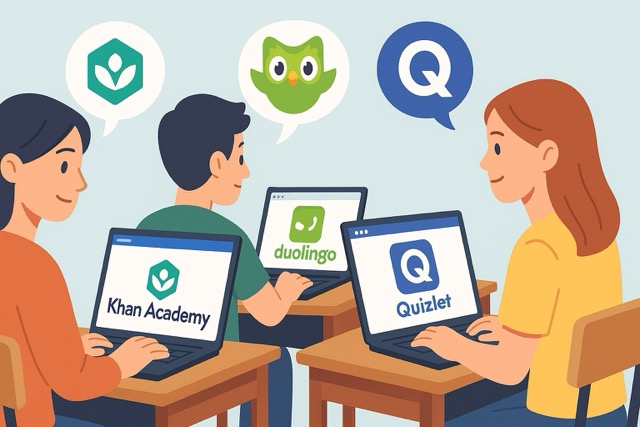
You already know that a search engine alone won’t get you through school. What you really need are trusted online tools that help you work smarter, build skills faster, and stay motivated through all the reading, revising, and researching. The right educational websites offer clear instruction, interactive practice, and even some much-needed inspiration when you’re stuck. This article introduces a curated list of platforms every student should keep close. Whether you’re brushing up on algebra, refining your essays, learning a new language, or diving into coding, these sites will help you tackle your academic goals with confidence.
Khan Academy: The Free All-Rounder
When you need a solid explanation without digging through a textbook, Khan Academy is one of the most reliable places to start. The platform covers math, science, economics, history, and SAT prep in a format that’s easy to follow. The short video lessons and guided exercises help you practice at your own pace, and the progress tracking feature keeps you organized.
What makes it even more effective is the clarity of its teaching. There’s no fluff—just straightforward instruction that adapts to your level. Whether you’re reviewing algebra or trying to understand a biology process, you’ll find something useful.
Coursera: Learn from Real University Professors
If you’ve ever wanted to attend a top-tier university without paying tuition, Coursera comes pretty close. This platform partners with institutions like Stanford, Duke, and Google to offer courses in everything from data analytics to psychology. You can audit many courses for free or pay if you want a certificate.
The strength of Coursera lies in its academic quality. You get access to lectures, reading materials, and assignments modeled on real college coursework. And with flexible deadlines, it fits well with your schedule, whether you’re working part-time or balancing multiple classes.
edX: University-Level Content Without the Price Tag
Like Coursera, edX offers classes from major institutions—MIT, Harvard, and Berkeley among them. If you’re pursuing a subject in-depth, edX’s MicroBachelor or MicroMaster programs allow you to build real credentials. But even if you’re just exploring, there are plenty of free courses with high educational value.
It’s particularly useful for STEM subjects, where structured learning and rigor matter. You’ll find engineering, statistics, programming, and other technical content, complete with quizzes and discussion boards for deeper understanding.
Grammarly: Write Like a Pro
Whether you’re writing a term paper, cover letter, or group chat with your study team, you want your words to come across clearly. Grammarly helps you sharpen your writing by spotting spelling issues, grammar slip-ups, and awkward phrasing in real time.
It also gives you suggestions for tone and style, which can be helpful when you’re switching between academic writing and more casual communication. You’re not just fixing errors—you’re learning how to express yourself better.
Quizlet: Memorize Without the Stress
When exams are approaching and you’ve got a mountain of terms to remember, Quizlet can save time and effort. You can create your own digital flashcards or search through millions already made by other students and teachers.
The platform lets you study in multiple modes—learn, write, match, and test—so you can switch things up if your brain gets tired of repetition. And if you’re someone who benefits from visuals or games, the format keeps the process interesting.
BBC Bitesize: Revision Without the Overload
If you’re studying at the middle school or high school level, BBC Bitesize is a goldmine of quick, focused learning content. It breaks down core subjects into manageable sections, with summaries, animations, and quizzes to help reinforce what you’ve just read.
It’s especially strong for UK-based exams, but many of the lessons are relevant for international learners too. When you want a break from long-form content but still need to stay on track, this is a site worth bookmarking.
Duolingo: Build Language Skills in Minutes a Day
Learning a new language doesn’t have to mean buying thick textbooks or memorizing lists of irregular verbs. Duolingo makes the process simple, approachable, and even fun. You get daily bite-sized lessons that help with vocabulary, grammar, pronunciation, and comprehension.
The streak feature keeps you motivated, and the app’s leveling system turns learning into a game. Whether you’re preparing for a study abroad program or just brushing up on Spanish, French, or Japanese, Duolingo makes progress feel achievable.
Codecademy: Start Coding with Confidence
If you’ve been thinking about learning to code but didn’t know where to begin, Codecademy offers a friendly starting point. The platform teaches programming languages like Python, HTML, JavaScript, and SQL through hands-on exercises that walk you through each step.
It’s beginner-friendly, but there are more advanced paths too—especially if you want to dive into data science, web development, or app building. The real value is in the platform’s interactive format. You write code and see the result right away, which makes learning immediate and satisfying.
Wolfram Alpha: More Than Just a Calculator
This tool might look like a search engine, but Wolfram Alpha is more like a computational wizard. Plug in a math equation, and it gives you not only the answer but also the step-by-step breakdown. You can use it for calculus, statistics, algebra, and even plotting graphs.
Outside of math, it can handle scientific conversions, timelines in history, and language data. It’s not about shortcuts—it’s about understanding the logic behind the solution, especially when you’re stuck on homework or prepping for a test.
TED-Ed: Expand Your Curiosity
Sometimes, you need a break from textbooks but still want to feed your mind. TED-Ed is packed with animated videos that explore everything from physics to philosophy. Each lesson runs for just a few minutes but is packed with content that sparks curiosity and deeper thinking.
What’s great is how well these videos connect knowledge to real-life questions. They’re a great way to warm up your brain before studying—or wind down with something thought-provoking after class.
Must-Bookmark Educational Sites
- Khan Academy – free lessons and exercises
- Coursera – university-level courses
- edX – academic programs and certificates
- Grammarly – improve your writing
- Quizlet – study with flashcards
- Duolingo – learn a language daily
- Wolfram Alpha – solve math step-by-step
In Conclusion
You don’t need to navigate your academic path alone. With the right online tools, you can study smarter, write better, and explore new subjects with confidence. These sites aren’t just helpful—they’re essential for modern students who want flexibility, quality, and results. Whether you’re grinding through finals, learning to code, or mastering a second language, having these platforms bookmarked puts the help you need just a click away.
Boost your academic success with these essential educational websites! For more insights on learning strategies, technology, and professional development, connect with me on LinkedIn.