
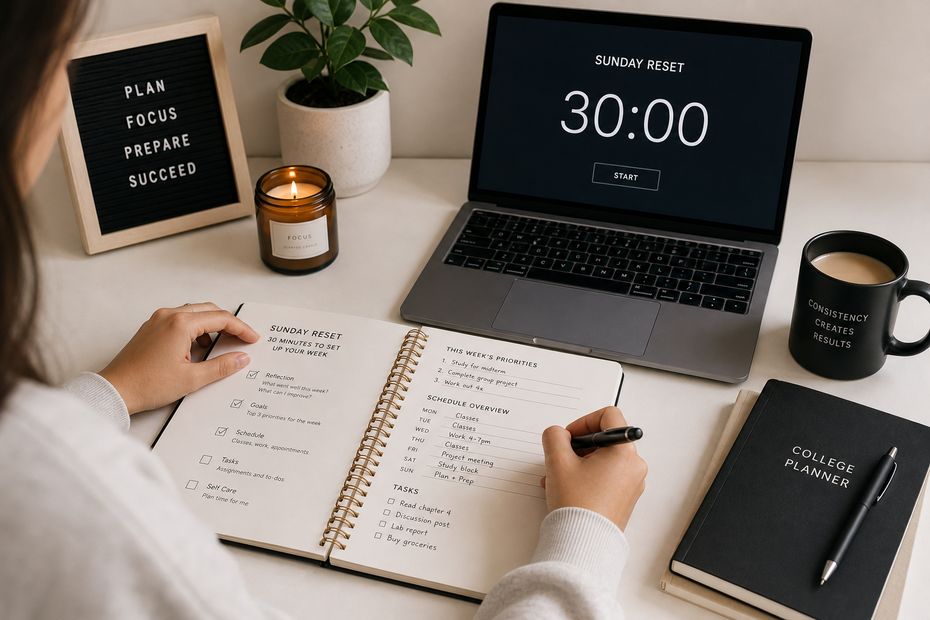
A college Sunday reset helps you plan the coming week in 30 minutes by turning scattered deadlines, commitments, and personal tasks into one workable schedule. Your goal is to give Monday a clear starting point, not to create a perfect plan for every hour.
Sunday can feel stressful when assignments are spread across syllabi, course portals, group chats, emails, and half-finished notes. A short weekly review gathers those loose ends before they compete for your attention on Monday morning.
This routine works in a dorm room, an apartment, the library, or during a break at work. You need one calendar, one task list, and enough honesty to plan around the week you’ll actually have.
Why Sunday Mornings Beat Sunday Nights For A College Reset
Sunday morning often gives you more mental space than Sunday night. You’re less likely to be reacting to an unfinished assignment, a late shift, or the realization that you need clean clothes for Monday. Planning earlier also leaves room to solve small problems before they become urgent.
You don’t need to wake up early or sacrifice your day off. Pick a 30-minute period before your day becomes crowded, perhaps after breakfast or before an afternoon commitment. If Sunday mornings never work, use Sunday afternoon or Saturday evening instead. Consistency matters more than the exact hour.
An earlier reset can also protect your evening. Once you’ve decided when academic work will end, you can rest without repeatedly checking course portals or rewriting your to-do list. Your calendar holds the plan, so your brain doesn’t have to keep rehearsing it.
What You’ll Need Before The 30-Minute Timer Starts
Keep your setup simple: one calendar, one place for tasks, and access to your course information. Your calendar can be Google Calendar, Apple Calendar, a paper planner, or another tool you already understand. Your task list can live in Todoist, Notion, a notes app, or a notebook.
Open each course syllabus, learning management system, school email account, and group chat before starting the timer. Gather any work schedules, club calendars, transportation details, or appointment reminders that affect the week. This preparation stops you from spending half the reset searching for passwords and course pages.
Avoid building a complicated student organization system during the reset. If a tool requires constant customization, color coding, or maintenance, it can become another unfinished task. Choose the smallest setup that reliably shows what you must do and when you can do it.
Step 1: Brain-Dump Everything Taking Up Mental Space
Set a timer for four minutes and write down every task competing for your attention. Include academic work, personal errands, messages you need to send, forms, supplies, laundry, and appointments. Don’t organize the list yet. Capturing the tasks is enough for this stage.
A brain dump removes the pressure to remember everything at once. It can include vague concerns too: start the research paper, ask about office hours, check the lab requirements, or figure out transportation for work. You’ll turn those concerns into clear actions later in the reset.
Stop when the timer ends, even if the list feels unfinished. Your syllabus and portal review will catch many missing academic tasks. A time limit also prevents the brain dump from becoming a long Sunday planning session that you start avoiding after two weeks.
Step 2: Check Every Syllabus, Portal, And Group Chat In One Pass
Use seven minutes to scan each place where deadlines and updates appear. Check your course portals in the same order every week, then review school email and relevant group chats. Record assignments, exams, readings, meetings, and changed instructions in your task list or calendar.
Don’t begin completing assignments during this scan. A five-minute reading can easily turn into an hour of work, leaving the rest of your courses unchecked. Capture the task, confirm the deadline, note any first action, and keep moving.
Watch for assignments that contain smaller hidden tasks. “Submit history essay” may require choosing a topic, finding sources, drafting, revising, and uploading the file. Add the first action you can complete rather than relying on one broad deadline. Regular review sessions also support steady learning by keeping course material visible before exam week arrives.
Step 3: Build A Time-Blocked Week Around Non-Negotiables
Spend ten minutes building the main structure of your week. Add classes, work shifts, appointments, commute time, meals, sleep, practices, and required meetings first. These fixed commitments show how much usable time you really have.
Place study blocks around that structure. Match demanding work with periods when you usually have more energy, and use shorter gaps for readings, emails, flashcards, or simple review. Academic skills centers often recommend scheduling study time rather than assuming free hours will automatically become productive hours.
Give each study block a specific purpose. “Chemistry problem set, questions 1 through 12” is easier to begin than “study chemistry.” “Draft the opening two paragraphs” gives you a clearer finish line than “work on essay.” Specific blocks also make it easier to continue after interruptions.
A variable schedule doesn’t make time blocking useless. Build the week using the information you currently have, then leave open blocks where work shifts or group plans may move. Treat the calendar as an adjustable map rather than a contract you’ve failed when Wednesday changes.
Step 4: Add The Unsexy Reset Tasks: Laundry, Meals, And Sleep
Use five minutes to schedule the tasks that keep the academic plan functional. Decide when you’ll do laundry, get groceries, refill prescriptions, prepare food, clean your desk, charge devices, and pack your bag. These tasks aren’t separate from college weekly planning because they affect whether you can follow the academic schedule.
Keep meal planning basic. You may only need to identify dining hall times, choose two easy meals, or check whether you have breakfast food for early classes. A realistic plan is better than a detailed menu you won’t use.
Review sleep alongside your morning commitments. An early class usually requires an earlier stopping point the night before, not a more ambitious alarm. Giving academic work a finish time can make your evenings feel less open-ended and reduce the temptation to keep working without a clear goal.
Step 5: End With Three Priorities And A Monday Jumpstart
Spend the last four minutes choosing three weekly priorities. These aren’t every task you need to complete. They’re the outcomes that deserve protection when the week becomes busy, perhaps submitting a major project, preparing for an exam, or completing paperwork tied to registration.
Then choose one small Monday jumpstart. Open the document you’ll need, place a textbook in your bag, download an assigned reading, or write the first question you need to answer. Reducing the first bit of friction makes it easier to begin when Monday arrives.
Your three priorities also guide schedule changes. If an extra work shift appears, protect the blocks connected to those priorities before moving lower-impact tasks. When something must be postponed, reschedule it immediately rather than returning it to a vague mental list.
Common Sunday Reset Mistakes That Eat Your Time
The first mistake is turning planning into decorating. Color coding can help you read a calendar, but adjusting fonts, icons, templates, and labels rarely solves a missed-deadline problem. Stop once the plan is clear enough to use.
Another mistake is filling every open hour. Back-to-back study blocks leave no room for meals running late, long walks across campus, unexpected conversations, or assignments taking longer than estimated. Leave some unassigned time so one delay doesn’t destroy the entire schedule.
Planning from memory also creates gaps. A planner can’t prevent missed deadlines when the information never reaches it, so scan every course source during the same weekly review. One consistent order reduces the chance that you’ll forget the class with fewer announcements.
Don’t treat an unfinished plan as proof that weekly planning doesn’t work. Review what changed, move the remaining task, and adjust future estimates. Following 70 percent of a useful schedule still gives you more direction than repeatedly rebuilding an unrealistic one.
A 30-Minute Sunday Reset Checklist For Dorm Life
Your reset should fit the space and attention you have. You don’t need a clean room, a quiet apartment, or an elaborate desk setup. Put on headphones if needed, sit wherever you can work, and follow the same short sequence.
- Minutes 0 to 4: Brain-dump academic, personal, and administrative tasks.
- Minutes 4 to 11: Scan syllabi, course portals, email, and group chats.
- Minutes 11 to 21: Add fixed commitments and focused study blocks.
- Minutes 21 to 26: Schedule laundry, meals, sleep, errands, and room tasks.
- Minutes 26 to 30: Select three priorities and prepare your Monday jumpstart.
If executive-function challenges make 30 minutes feel too long, use five-minute timers within the reset. Keep the checklist visible and mark one stage at a time. You can also split the routine into a 15-minute schedule review and a 15-minute dorm reset without changing the main goal.
What Should A College Sunday Reset Include?
- Review deadlines, exams, and assignments.
- Block classes, study time, and commitments.
- Plan meals, laundry, sleep, and personal care.
- Choose three priorities for the week.
Give Monday A Clear Starting Point
A college Sunday reset won’t control every shift change, group project delay, or surprise assignment. It will show you what matters, where your available time sits, and which task should begin the week. Keep the routine short enough to repeat and flexible enough to survive imperfect weeks. Review every course source, block real commitments, protect three priorities, and leave breathing room. Thirty focused minutes on Sunday can replace Monday morning guesswork with a plan you can actually follow.
Resources
- University of North Carolina Learning Center: Tips And Tools
- Cornell University Learning Strategies Center
- Dartmouth Academic Skills Center: Time Management
- Harvard Academic Resource Center
- Cal Newport: Student Productivity And Planning
- James Clear: Habit And Routine Articles
- Mental Health America: Time Management