
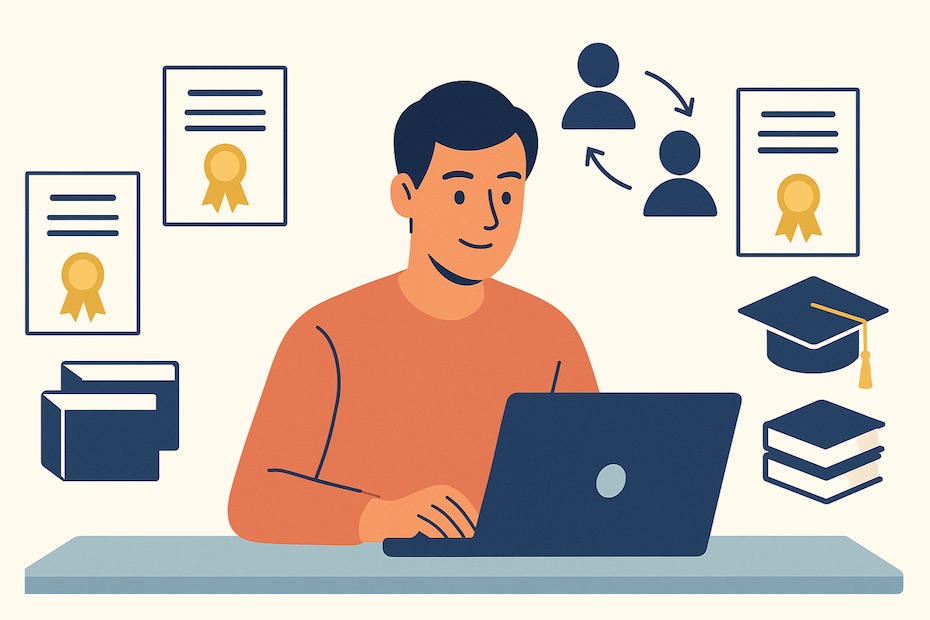
The online certificate boom is happening because short credentials deliver faster career outcomes, cost less than degrees, and align directly with employer skill demands.
In this article, you’ll see why certificates are growing faster than traditional degrees, how employers treat them, and what benefits you gain from stackable, career-focused, and affordable credentials.
What explains the sharp increase in short-term certificates?
Short-term certificates are increasing because they give learners faster access to career-relevant skills.
Data from the National Student Clearinghouse shows that certificate completions rose 11.2% in 2023–24, while bachelor’s degrees declined slightly. Employers in industries like IT, healthcare, and business operations now recognize certificates as proof of focused expertise.
As an educator or professional, you can already see this shift—more learners choose six-month certificate courses instead of multi-year degrees to quickly enter or move up in the workforce.
How do micro-credentials influence hiring and salary outcomes?
Employers consistently reward candidates with certificates when those credentials are relevant to the job.
A Lumina Foundation study found that 9 in 10 employers believe micro-credentials improve job applications, and many report they’re willing to increase starting salaries for candidates with targeted certificates. Pay increases average 10–15% for certificate holders in areas like data analytics or project management.
This means if you earn the right certificate, you position yourself competitively—even without a traditional degree. Employers now treat certificates as evidence of specialized, actionable skills.
Why are universities embedding certificates into degree programs?
Universities are embedding short credentials into traditional degree structures to make programs more flexible and career-focused.
AACSB research highlights that 97% of employers are already practicing or considering skills-based hiring. Universities respond by integrating industry-recognized certificates into their degree programs. For you, that means earning micro-credentials during your degree journey that are immediately valuable in the job market.
The model ensures you don’t wait until graduation to show proof of skill. Instead, you gain incremental certifications that employers recognize at each stage.
What does stacking credentials mean for students?
Stacking credentials means you can earn small certificates over time that add up to a full degree or advanced qualification.
This system motivates learners by providing incremental wins along the way. Western Governors University and edX, for instance, let students accumulate IT, healthcare, or business certificates that eventually convert into bachelor’s degrees. Some institutions reported completion rates rising by up to 70% when they adopted stackable models.
By stacking credentials, you create flexibility: you can pause, work, and return to your studies later without losing progress.
Do short certificates deliver measurable employment gains?
Yes, but the results depend on the relevance of the credential to the labor market.
The Wall Street Journal found that only 1 in 8 nondegree credentials leads to measurable pay or career improvements within a year. However, when aligned to high-demand fields like nursing, cybersecurity, or cloud computing, the payoff is clear: some learners reported annual income increases of $5,000 or more after earning the right certificate.
This is why alignment matters. If your certificate is in-demand and employer-recognized, you can expect tangible career gains within a short timeframe.
How does credential visibility affect job opportunities?
Making your certificates visible online directly impacts your career opportunities.
Coursera data shows learners who shared certificates on professional platforms had a 17% higher profile visibility and were 6% more likely to report new employment. Visibility signals competence, helping recruiters prioritize your profile when searching for candidates with specific skills.
For you, this means actively adding credentials to LinkedIn, resumes, and digital portfolios. The act of sharing validates your learning achievements and amplifies their career impact.
Why are certificates critical for lifelong learning?
Certificates empower you to keep pace with shifting industries by offering short, affordable pathways to reskill or upskill.
They’re particularly valuable for mid-career professionals who need to adjust to automation, digital tools, or evolving regulations. Micro-credentials let you address skill gaps without the cost or time of pursuing an entirely new degree.
With more employers investing in tuition reimbursement for certificates, you can continually sharpen your skills while staying relevant in the workforce. This makes lifelong learning both practical and sustainable.
Key Reasons why Short Certificates Are Booming
- They provide faster, career-relevant pathways.
- Employers value them and often increase pay for certificate holders.
- Universities embed them into degree programs to improve flexibility.
- Stackable credentials keep learners engaged and moving toward degrees.
- Relevant certificates can yield $5K+ salary growth in one year.
- Sharing credentials online improves job visibility and hiring chances.
- They enable lifelong learning at lower costs.
Why Online Certificates Are Growing
Online certificates are booming because they offer affordable, flexible, career-focused training, improve job visibility, and align with employer demand for measurable, in-demand skills.
In Conclusion
You’re seeing online certificates reshape the education and employment system by offering speed, affordability, and relevance. Whether embedded in degree programs, stacked toward qualifications, or pursued independently, these short credentials give you measurable career benefits. By earning, stacking, and showcasing them, you stay competitive and future-proof your professional journey.
For more insights and curated ideas on education, careers, and creativity, feel free to explore my collections on Pinterest.